
ESEN
Case — Games industry · USA · global reach
From their website to their product: two years as CDR's design team.
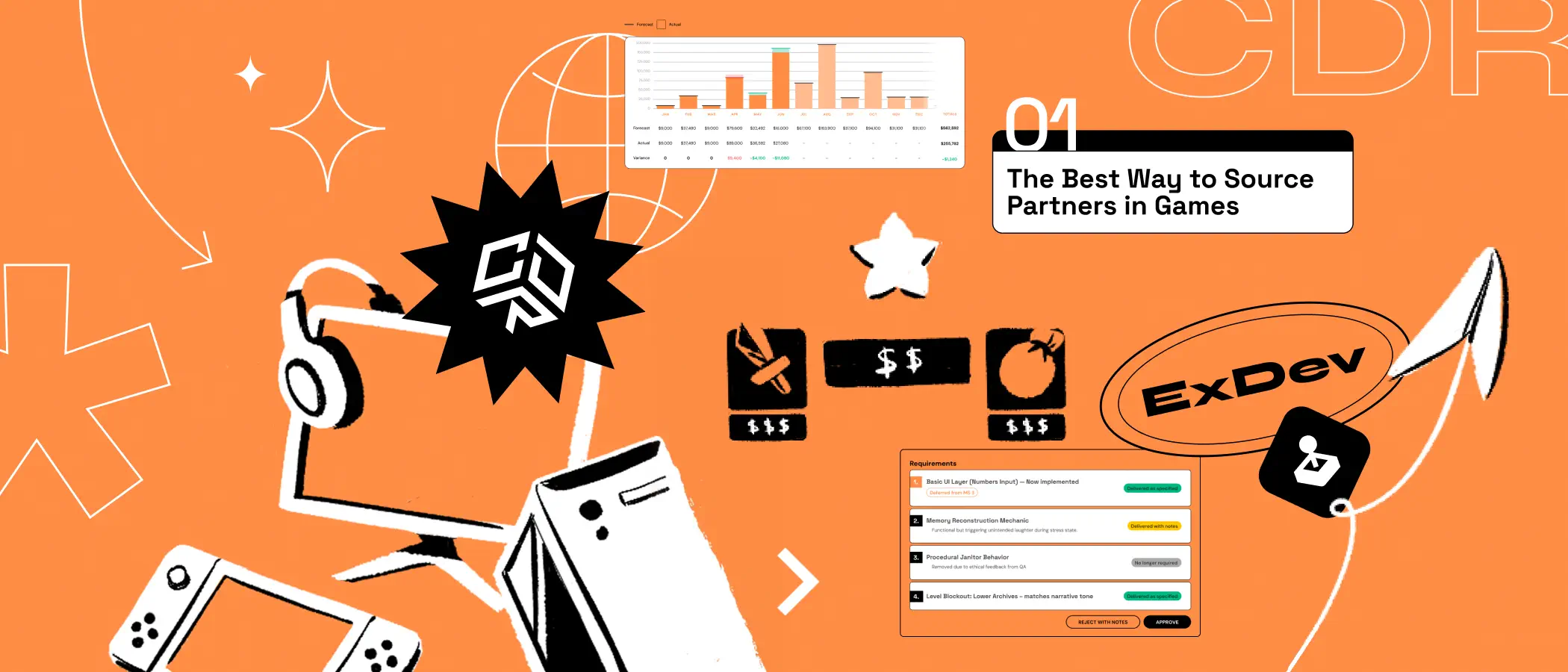
CDR is a California-based external development consultancy for the games industry, working at the intersection of games, AI and market intelligence. A growing team with no in-house design department, needing to signal credibility to AAA game companies and, the biggest leap, turn their market knowledge into a software product of their own.
They didn't need a web designer: they needed a strategic design ally able to move across brand, communication and product, understanding the language and dynamics of the games industry, to elevate their communication to the level of the service they already offered and the product they were building.
The process
CDR's initial identity and first website, from scratch (July 2024). Then two full redesigns (2025 and 2026) plus ongoing evolution: blog, open positions, forms. We built on Webflow with structured content, so the site evolves at the pace of the business and CDR manages it with full autonomy.
Sales deck and presentation design. CDR provides the context and the information; Prisma channels it visually, with a graphic system and custom illustrations that reinforce each message, from sales proposals to complex concepts like market coverage. We use imagery with intent: it appears at the key moments of each presentation to reinforce the core idea, rather than decorating every slide.
End-to-end UI/UX design for the CDR CLM since mid-2025: real-time dashboards for budgets and forecasts, milestone approval flows, contract governance. Working on complex specs, iterating directly with the founder. For complex UI problems, we explore proven patterns and reference products, then present resolved flows and component variants: decisions get made on real screens, not abstract ideas.
The result
Services provided
Timeline
Key learnings
We research constantly, learn the acronyms and look up what we don't know: absorbing the client's language is what lets the design speak it natively.
For complex UI problems, arriving with explored references and proven patterns turns every meeting into a decision instead of a debate.
One illustration at the right moment beats ten fillers: scarcity is what gives imagery its power.
A visual system built for a consultancy can scale to a product company if the foundations are right: no rebrand needed, just evolution.